“I never before knew the full value of trees. My house is entirely embossomed in high plane-trees, with good grass below; and under them I breakfast, dine, write, read, and receive my company. What would I not give that the trees planted nearest round the house at Monticello were full grown.” ~Thomas Jefferson, 1793
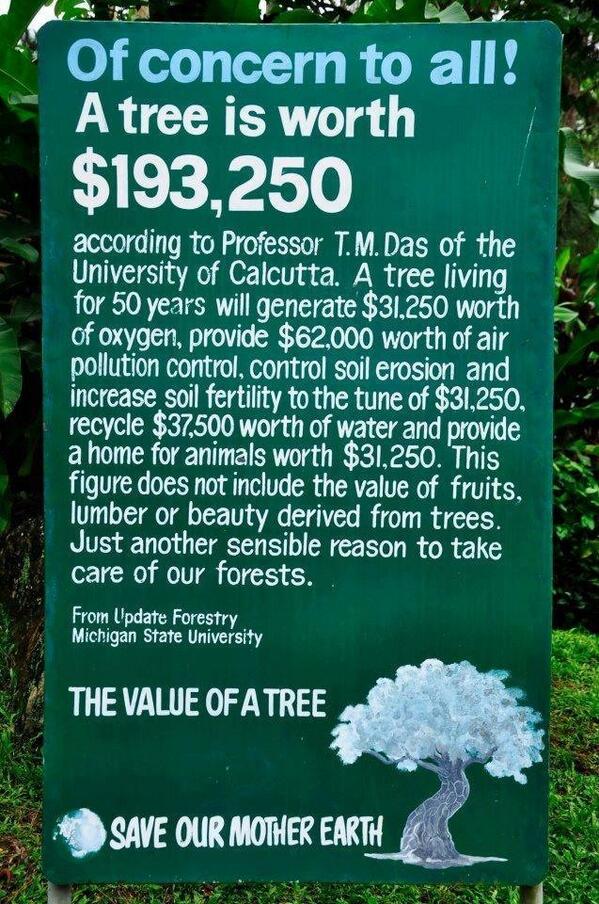
Most of the things in nature needed to sustain life are taken for granted by human populations. Fresh water, clean air, and fertile soil are basic requirements for a healthy existence. This natural capital is an undervalued commodity often overlooked as people live their lives pushing through rush hour traffic and supermarket checkout lines. Many no longer see the forest through the urban jungle, and this separation affects our perception of nature. The need to place economic value on nature is increasing exponentially. People understand the worth of a dollar faster than they understand the merit of a tree. This type of valuation helps garner support for the preservation and conservation of natural systems. It is tied directly to the initial impact of loss. Attention is quickly given to what hurts in the short term. The least amount of attention is given to the loss down the road that cannot be seen so clearly. The externalities of the Industrial Revolution, an event still lingering in the rear view mirror of history, have placed us on the edge of self-destruction. Climate change is affecting our forests, as are degradative and consumptive attitudes towards forest resources. These resources are a wellspring of economic power as well as both environmental and cultural health. As such, our forests and trees should be valued and revered.
An externality, in economics, is a cost or benefit that affects someone who did not choose that cost or benefit. Externalities from the industrial revolution are the movement from skilled labor to the mechanization of production, the population boom, the shift from rural societies to urban and suburbanization, and many types of environmental degradation, one being deforestation. Today’s environmental regulations, such as requirements of scrubbers on smokestacks at coal and energy plants, are an attempt to get industry to internalize some of these externalities. In the end, the real cost is always extrapolated out to the consumer.
The consumption and destruction of forests has become an unaffordable, unsustainable practice. One of the global impacts of anthropogenic climate change on tree populations along the Northeastern United States is tree migration, which is the progression of tree species northward following the migration of climatic regimes. They are underway at a rate that spells disaster. Forests of the Northeast have already begun to respond to annual temperature pattern changes driven by increased greenhouse gas levels in the atmosphere. Researchers estimate that a forest naturally moves at most a half mile in a year. With the current rate of temperature change in this region, trees cannot migrate fast enough to keep up with shifting climate patterns1. At first look, this may seem trivial. However, loss of remaining forests bears the force of externalities that will impact the health and well-being of human populations in the Northeast and elsewhere. Conversion of forests to scrub and secondary secession plant communities will have lasting effects on the soil, plant and animal populations, and human populations. Trees die silently, and the impact of their loss is often not instantly recognized.
In Vermont, maple syrup production has fallen from a market dominating 80% in Thomas Jefferson’s day to 20% today2. In order to produce syrup, the trees require freezing temperatures at night and a gentle thaw in the day with a weak temperature gradient between the high and low. It’s the perfect mix of cold and colder. This small meteorological window is moving and closing in the normal range of habitat for this tree. Climate forcing models have shown us that individual tree species migrate at different rates in response to climate change. Data taken from satellite imagery has been used to monitor forest change in the United States for over 15 years. It shows the sugar maple is one of 70% of Northeastern trees on the move3. It’s taking the mass of that sweet syrup with it to Canada.
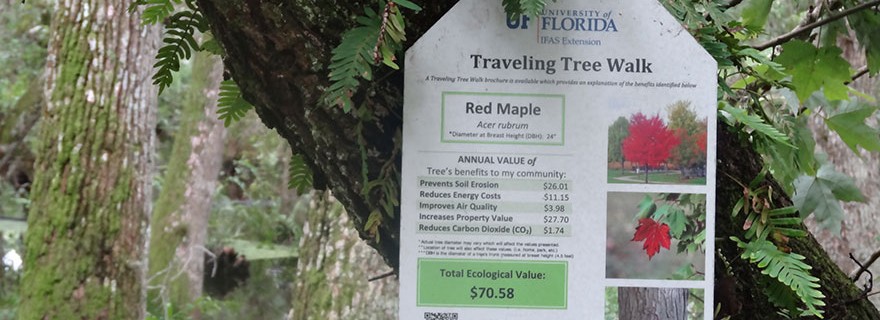
Here in Florida, the University of Florida (UF) gives the yearly worth of a Red Maple to a community at $70.58. This value is calculated based on prevention of soil erosion, reduction of energy costs, improvement of air quality, increase of property value, and reduction of CO2 in the atmosphere. There is a trend among forest resource managers to express the value of urban trees in dollars because this stops people from tearing them down in the name of progress. Ecosystem services provided by trees and forests extend beyond what’s given on the Red Maple tag below as part of the Pinellas County Traveling Tree Walk. Trees regulate the atmosphere, assist in water storage and filtration, contribute to nutrient cycling, provide habitat for plants and animals, and are aesthetically pleasing.
Of course, tree migrations will affect more than our sweet tooth and sense of national pride. Predicted forest loss is burdened by a positive feedback loop, another silent killer of climate change. As trees die and rot away, they release carbon into the atmosphere, driving the rates of anthropogenic warming and climatic temperature rise, killing off larger tree populations². It is literally adding fuel to a fire that will affect the quality of our soil, the plant communities available for animal populations, and water quality/water flow across our watersheds. It will also affect our sense of place. The reds, yellows, and oranges of a New England autumn may become strictly a Canadian sight. Spruce boughs bending with snow in an Appalachian winter may become a vision of days past as spruce migrate northward chasing winter.
The lack of inclusion of the true value of our forests into functional economic equations, such as IPAT, leads to a deficiency in awareness of the necessity of healthy wilderness as it relates to human populations. For generations, natural resources have been the fuel for human development and ingenuity. These advances have come at a price, and eventually, we all must pay the full cost of human exploitation of the environment. Monkey wrenching, political struggle, and spiritual connection have not been enough to bring a halt to human disregard for forests and trees. Extrapolating out the true cost of our endeavors may well provide the transitional step necessary to guide human populations away from over exploitation. As with every strategy, it must be one of many in a tool box for changing our attitudes toward forest resources and consumption. Relying too heavily on any one strategy can take away from the integrative strength necessary to create change that goes against the economic will of many nations, the United States included.
Sources:
1McKibben, B. (2006). “A New Atmosphere”. The End of Nature. New York: Random House.
2Casey, Constance. “Why the United States is No Longer the Maple Syrup Capital.” Slate. The Slate Group. April, 2007. Web. http://www.slate.com/articles/news_and_politics/gardening/2007/04/the_migrating_maple.single.html
3 Woodall, Christopher. “Study Suggests Tree Ranges Are Already Shifting Due to Climate Change”. U.S. Forest Service Northern Research Station. 2010. Web. http://www.fs.fed.us/nrs/news/review/review-vol11.pdf
 Peeling Back the Moon