Humans fixate on classification. We are a race that defines terms, locates parameters, dissects systems, and gives name to the world around us. This ability to identify distinction and define difference has been used by geologists to date the Earth and show layers in her sedimentation that help explain the evolution of life. The Earth holds the key to past extinctions in her stratigraphy. Decoding this mystery of rock and time has given way to the geologic time scale. This basic point of reference is well accepted in scientific circles and taught in all geology texts. From the dawn of time as we know it during the Precambrian to the Holocene epoch of today, change has left a permanent mark on the internal structure of the planet. Holocene, derived from Greek and meaning “entirely recent”, marks the end of the last major glacial retreat. With it, forests began their spread across the continents and the agrarian revolution took root. Humans populated the planet. Certain charismatic megafauna, such as the woolly mammoth and saber tooth tiger began to disappear as they were hunted to extinction. As recently as 2000, Paul Crutzen, a Dutch chemist, threw out the term Anthropocene to describe a new age marked by the negative imprint of human existence on the Earth1 brought on by the Industrial Revolution and the Great Acceleration. These changes are anthropogenic, hence, Anthropocene. But is there evidence for this? Has humanity entered a time that is distinct from the Holocene, newer than entirely recent? Evidence is suggesting this is very possible.
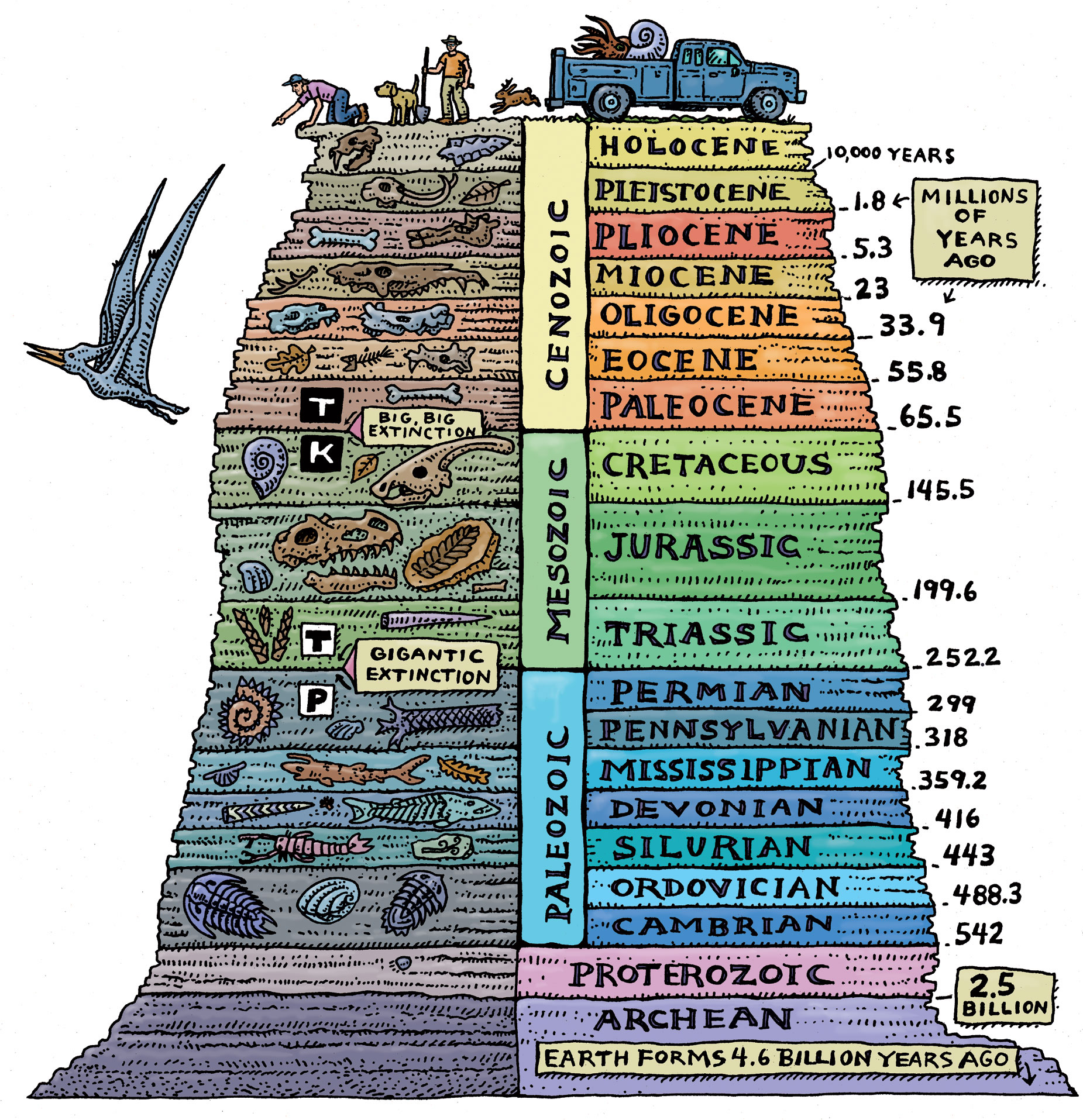
Declaring a new geological time is no casual matter. The International Commission on Stratigraphy (ICS) is the global authority, and has a subgroup working on this. The Subcommission on Quaternary Stratigraphy’s main purpose within the structure of the ICS is “the establishment of a standard, globally-applicable stratigraphic scale”². As such, they hold committee on the Anthropocene working group. The Anthropocene may be an epoch, meaning it is of the same order as the Holocene. The beginning of the Anthropocene would mark the end of the Holocene under this determination. The Anthropocene may be nothing but a buzzword, or, the Anthropocene could be a potential division of the Holocene – a blip in her rock record, if you will. The working group is seeking the “golden spike”, a global marker in the stratigraphic record that gives evidence of this human induced change. Two strong indicators are on the table.
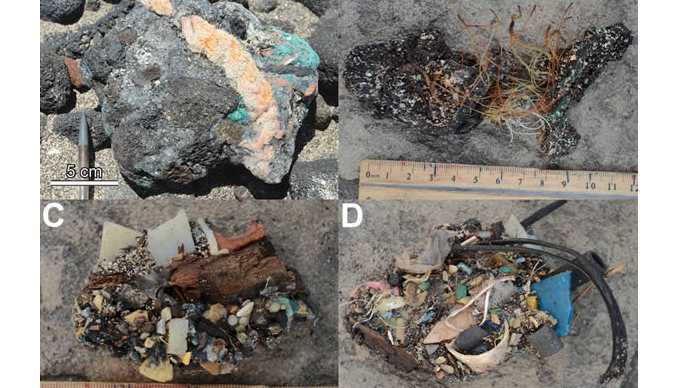
One is plastiglomerate³. Scientific American and Science Friday, the Huffington Post and Discovery are all talking about it, and it all goes back to one paper, An anthropogenic marker horizon in the future rock record. In it, the authors (some of whom are members of the Anthropocene working group) discuss a new rock type discovered on Kamilo Beach in Hawaii. People have discarded so much plastic that it accumulates in dense mats in the gyres of our oceans. It washes up on beaches. It is tumbled by waves, worn by friction, and weathered by sand. It melts in the basaltic lava flows of Kamilo where Pacific currents and geomorphology carry it ashore. It makes a new rock, plastiglomerate, which is composed of basalt, sand, plastic, and whatever else sticks in the mix. It has a density that encourages transport and deposition. It could make itself a part of the sedimentary strata. It is most certainly permanent.
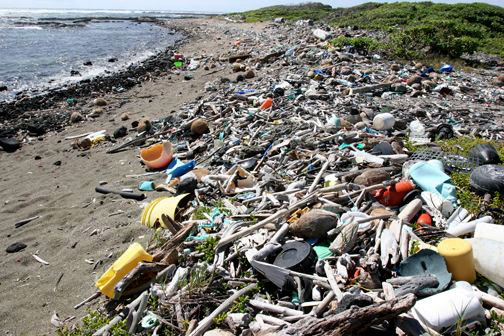
An issue with plastiglomerate as a golden spike is distribution. When seeking a uniform signature in the strata, a wide range of deposition is required. Plastiglomerates may one day hit this kind of global spread, but it hasn’t happened yet. Other indicators show the mark of human life on the atmosphere.
Atmospheric tritium, carried into groundwater via rainfall, allows for age dating of young groundwater. This is possible due to the detonation of nuclear bombs in the 1950’s and 1960’s. Tritium is a rare atmospheric radioactive isotope of hydrogen and a necessary component of nuclear weapons. With a half life of 12.7 years, it breaks down quickly and has a known deposition period. It’s global, but it’s not in rocks. It doesn’t hang around long enough. Other chemical signatures date to this time as well. However, something a bit more tangible would be better to explain a new geologic time.
Another feasible marker would be fly ash particles. Fly ash particles are emitted into the air via flue gasses from smokestacks and other noxious emissions. The combustion of fossil fuels at the onset of the Great Acceleration are measurable on a global level in lake sediment cores. There is a spike in fly ash particulate matter distribution in lake beds that is both global and synchronous4, making fly ash a strong competitor in the search for a golden spike. The particles themselves have no “natural source”³ outside of fossil fuel combustion. This makes them a clear indicator of human activity that is changing the atmosphere, surface and substrata of our planet.
The Anthropocene working group is looking at these markers and seeking to make a determination by 2016, and this matters. A lot. A geologic age must be marked by a measurable change in the rock layer. The evidence is mounting. The term anthropocene is almost more than a buzzword describing anthropogenic change to the environment tossed around by scientists, policy makers, and environmentalists. It is on the verge of becoming a new geologic epoch. However, there is no debate that humanity is leaving a negative mark on the planet. Trash floats in our oceans and fills the stomachs of birds and fish alike. Industry pumps greenhouse gases and particulate matter into the atmosphere at alarming rates. Deforestation and mass extinction are global issues most brush by on the way to work in the morning. What humanity lies down on top of 4.6 billion years of evolution is definitive. It can’t be taken back. The human fingerprint is changing the natural world. It is up to humanity to change the shape of its fingerprint.
Sources:
¹Kolbert, Elizabeth. The Sixth Extinction. New York. Picador, 2014. Print
²Subcommission on Quaternary Stratigraphy. International Commission on Stratigraphy. 25 Jan. 2015. Web. http://quaternary.stratigraphy.org/
³Corcoran, et al. An anthropogenic marker horizon in the future rock record. GSA Today. Geologic Society of America. 8 Nov. 2013. Web. <http://www.geosociety.org/gsatoday/archive/24/6/article/i1052-5173-24-6-4.htm
4Rose, Neil. Spheroidal Carbonaceous Fly Ash Particles Provide a Globally Synchronous Stratigraphic Marker for the Anthropocene. Environmental Science & Technology.19 March 2015. Print.
 Peeling Back the Moon
I wonder if acid rain might leave a world wide record in stone? It certainly has melted the inscriptions off of tombstones in New York as I have personally seen
LikeLike