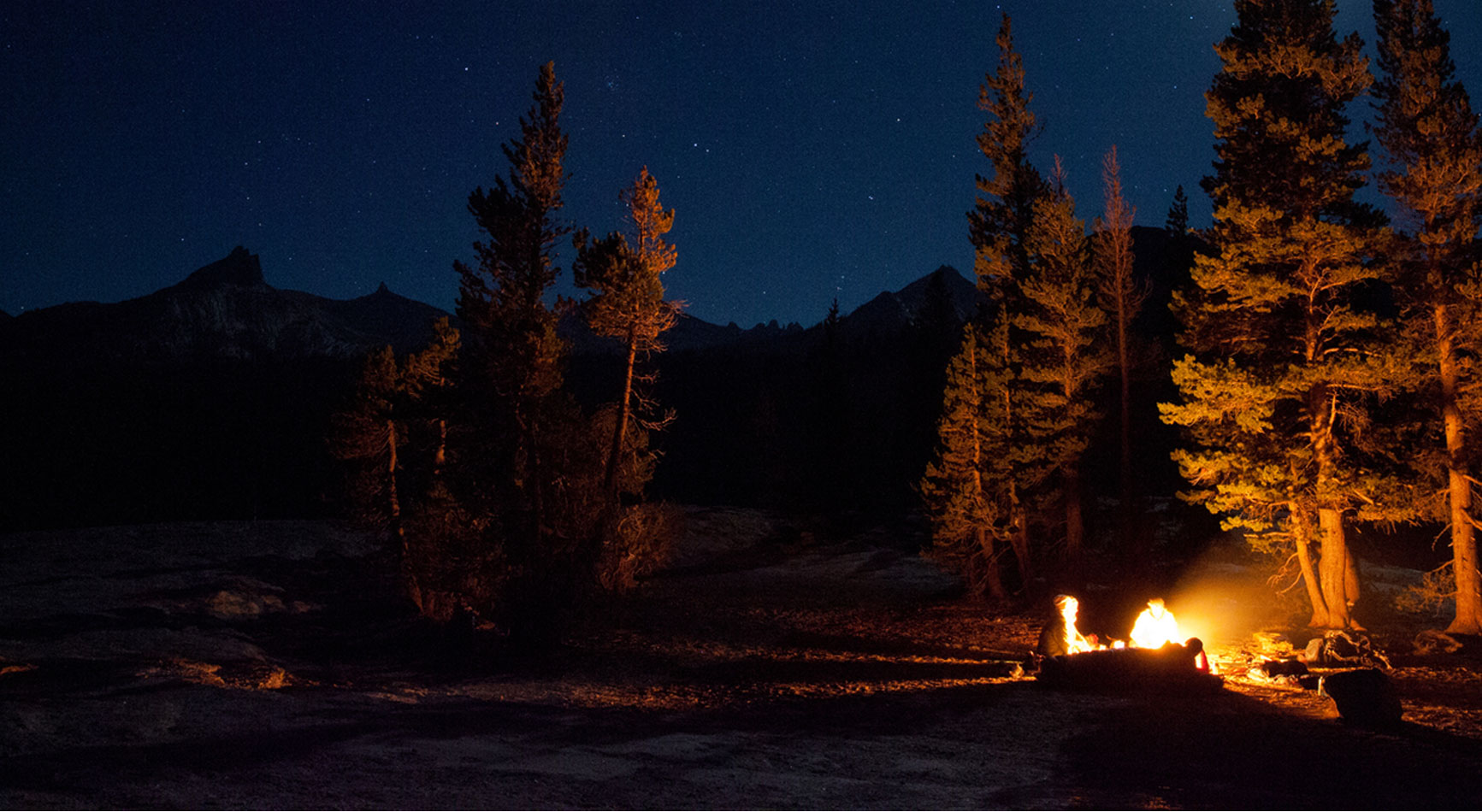
Featuring: John Muir, Paul Shepard, Garrett Hardin, and Ramachandra Guha
This piece presents four famous authors within the environmental movement sitting around a campfire. The flames dance. The wood sparks and pops against the backdrop of a dark night sky. The fire reaches for the stars. They have met for a chat on the state of the global environmental crisis. What is causing it? What can be done, if anything? Let us join them and hear what they have to say.
“It doesn’t make much sense that we’re burning wood and releasing CO₂ into the atmosphere. Is this fire really necessary,” Hardin questions. “It brings us closer to our primal selves”, Shepard replies. Muir stares mystically at the stars and the boughs of pines dancing with the wind in the fire and moonlight. Guha shakes his head. “You know, you can’t solve the deforestation issue by simply preserving land in undeveloped countries and keeping people out. That solution will not work outside the U.S. It’s not working that well in the U.S. for that matter. Perhaps the global demand for palm oil is doing more harm than our fire in the woods on a chilly night.”
“Guha, you’ve got a point,” Shepard chimes in. “We would do well to combat the global environmental crisis, and issues like deforestation for global cash crops, with a healthy dose of bioregionalism inspired by a drive to return to our more primitive roots. Our Paleolithic ancestors were more concerned with the ebb and flow of seasons than of markets. Indeed, if we focused more on bioregionalism and living where we are with what we have, extended families would potentially strengthen, shoring up the walls of community. You don’t need Southeast Asian palm oil for that.”
“There can be no freedom in the commons”, Hardin shouts vehemently. “Privatization is a good solution, and keeping people out is a great answer. Leave it to a mass of people to foul the air and dirty the water. This little campfire is nothing, but leave a primitive family in the woods for a year and see what levels of nature they bring to destruction. Leave them with their extended family under this bioregionalism thing Shepard keeps boasting about and see where that gets any of us! No. No, I tell you. It is better yet to build fences and stop these infantiles from uncontrollable reproduction. This planet cannot produce enough to meet the needs of all these people. Next thing you know, Earth will be one gigantic welfare state.”
“Settle. Settle down now. Listen to the wind in the trees. Feel the stars lighting up the night sky out here in God’s cathedral. No one of us is better than the other. No one of us deserves this space more than another. Why, all of God’s creatures have the right to call this Earth their home. We would do well to set aside land for them – a place we can go but never stay, a place that is pristine physically and spiritually. The clearest way into the Universe is through a forest wilderness. I would like to see that door always open, see more people in the world rather than on it.”
“What are we going to do as the seas rise? None of the world leaders seem willing to do enough to curb greenhouse gas emissions. However you look at it, we do seem to be heading into ecological crisis and mass extinction,” Shepard states.
“You know, Nietzsche said a bad conscience is a kind of illness. I say we just let this thing run its course. It’s bound to help with the population issue. If people aren’t smart enough to get out of the way of rising water, if they can’t think their way around their environmental problems, let them make way for those who can. Those who are more biologically fit to cope with a changing Earth will plod on and I will feel no worse the wear for it. There is no such thing as a perfect system.”
Guha shakes his head taking it all in. “Americans become so entangled in their arguments. It’s as if their solutions are arguments defined to prove they have a better answer than someone else! Wouldn’t it be better to just solve the issue itself rather than building up all this ideological grandiosity around it? People, all people, deserve a life on a healthy planet with access to the resources they need to survive and thrive. Hardin, the problem with your suggestion is that it places all the power in the hands of the few elites in control. There’s no equity in that. There can be no environmental justice without considering the justice due to all human beings.”
“All human beings and all sentient creatures alike, I would argue,” Muir adds. “Especially the bear, for he is a noble creature indeed. Perhaps there is a way to legislate temperance into today’s hectic society. Maybe we could take away some of the resources that do the most damage using law and treaty as our sword.”
“There is some evidence that could work”, Hardin adds. “Regulation can make a difference. I once suggested we regulate entrance to our National Parks as a way to reduce degradation.”
“Let the people come”, Shepard avers. “Let them come and walk among the trees, mountains, and clouds of their primal home. Let them embrace that which they can always hear calling them. Let’s help them put a name to the voice of their Mother Earth dancing around in the modern confusion of their minds. Just not all at once. I, for one, am kind of enjoying the quiet.”
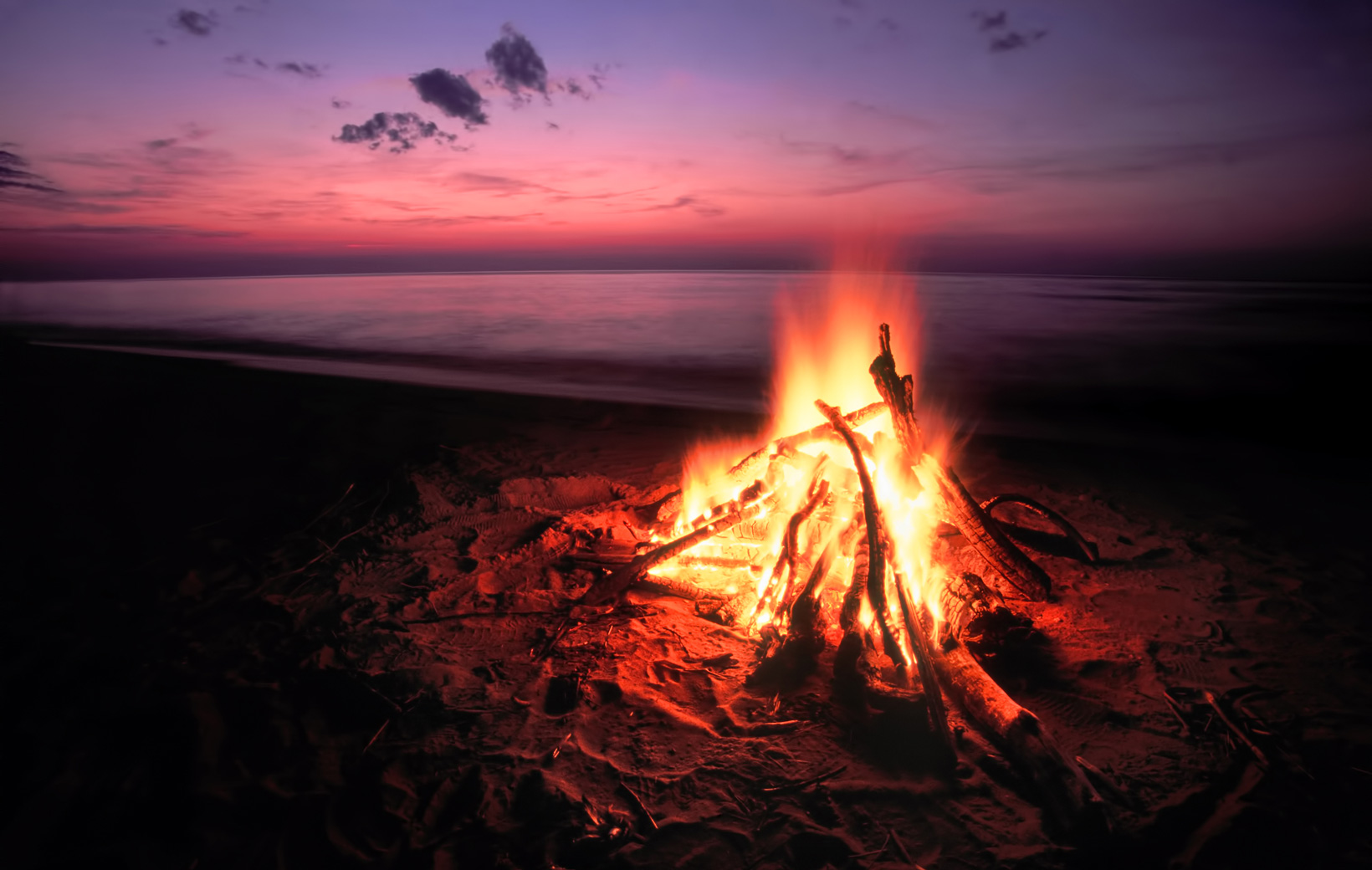
There is never only one perspective. There is never only one solution to a problem. There are many voices. There are many ways to make a difference. Find your voice. Make your contribution.
Guha, R. (1989). Radical American Environmentalism and Wilderness Preservation: A Third World Critique. Environmental Ethics, 11, 71-83.
Hardin, G. 1968. The Tragedy of the Commons. Science, 162.
Shepard, P. (1998). Coming Home to the Pleistocene. Washington, D.C.: Island Press.
Teale, E & Muir, J. 1954. The Philosophy of John Muir. The Wilderness World of John Muir. Houghton Mifflin. Boston.
 Peeling Back the Moon
Governor James R. Thompson of Illinois quoted with evident approval Sir Winston Churchill as saying, “You can depend upon the Americans to do the right thing. But only after they have exhausted every other possibility.”
LikeLike